
THE LIVING CANON
Civilizational Memory, Relational Measure, and the Missing Nordian–Pleiadian Continuum from Egypt through Athens to Rome

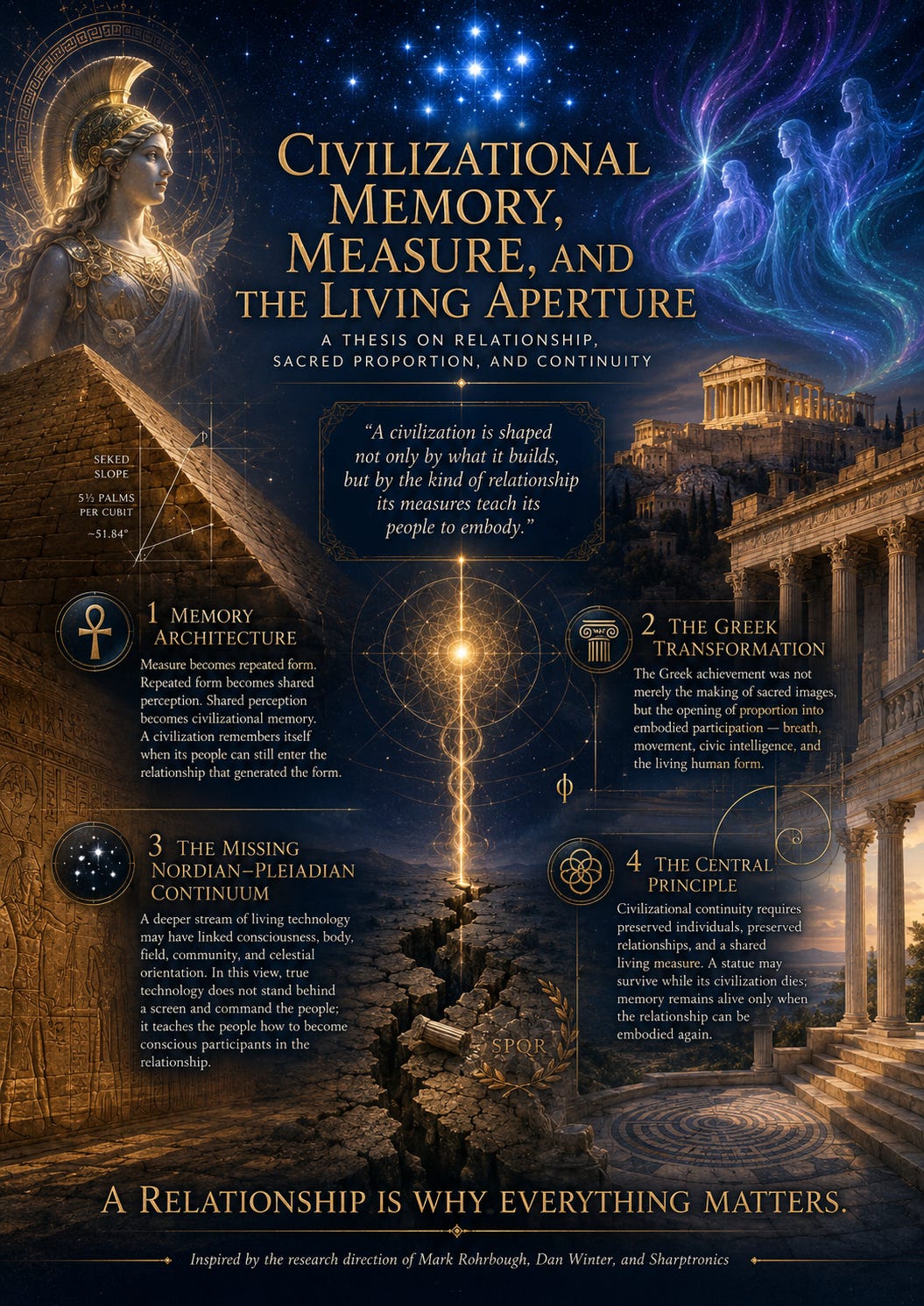
THE LIVING CANON

Civilizational Memory, Relational Measure, and the Missing Nordian–Pleiadian Continuum from Egypt through Athens to Rome


1. ABSTRACT

A civilization does not survive merely because its monuments, names, statues, formulas, and institutions remain visible. Civilizational continuity depends upon preserving the relationships that originally gave those forms meaning.

This thesis examines ancient Egyptian, Aegean, Greek, Sumerian, Babylonian, Nordian–Pleiadian, and Roman traditions as different architectures of measure, memory, participation, and authority. It develops the proposition that measurement systems are never exclusively mathematical. A canon of proportion can become a civilizational operating system: it influences how individuals understand the body, the community, the sacred, political authority, the natural world, and their relationship to the cosmos.

Egyptian seked measurement and proportional canons helped preserve a highly ordered sacred and institutional civilization. Greek civilization inherited knowledge from Egypt and the wider eastern Mediterranean, but transformed portions of that inheritance into a more embodied, argumentative, civic, and participatory mode. During the Athenian Golden Age, the works associated with Phidias expressed a civilization attempting to bring divine intelligence, bodily proportion, public identity, architecture, and collective imagination into a unified field.

This thesis does not claim that Phidias demonstrably designed with the exact mathematical constant now represented by ϕ. Instead, it proposes that the philosophical meaning of ϕ provides a useful language for interpreting a relational principle visible in Greek thought: the whole, the individual, and the relationship between parts may remain mutually proportionate without requiring the erasure of any member.

The thesis also introduces a missing Nordian–Pleiadian continuum. This continuum is presented as a cosmological and civilizational hypothesis rather than established archaeology. In this model, Nordian and Pleiadian technology refers not primarily to machines or physical appearance, but to a living technological tradition in which consciousness, biology, geometry, breath, memory, ethics, and community remain interoperable.

Athena is studied as a possible convergence aperture: an inherited Aegean memory associated with wisdom, weaving, craft, civic protection, strategic intelligence, and relational sovereignty. Her name may contain a linguistic layer older than Classical Greek, but its precise origin remains unresolved. Linear A remains undeciphered and cannot presently prove an Atlantean, Lumærian, Nordian, or Pleiadian origin.

Rome subsequently preserved and transmitted extensive portions of Greek civilization while also introducing conquest, appropriation, centralization, standardization, spectacle, and imperial mediation. The Roman continuum was therefore both a preservation mechanism and a fracture. It often retained the visible forms while modifying the civic and relational conditions from which those forms had emerged.

The central proposition of this thesis is:

Civilizational memory remains alive only when people can consciously re-enter, reproduce, and transform the relationships that generated their inherited forms.

A statue may survive while its living meaning disappears.

A word may survive while its original memory is lost.

A mathematical ratio may survive while its relational purpose is forgotten.

A civilization truly continues when its people remember not only what their ancestors constructed, but how to participate in the relationships that made construction, imagination, freedom, and collective coherence possible.


2. CENTRAL THESIS

A civilization is an organized field of remembered relationships.

Its buildings, symbols, languages, laws, myths, technologies, and institutions are external expressions of those relationships. They are not the civilization itself. They are vessels through which a civilization attempts to preserve its internal formation across generations.

Civilizational continuity may therefore be represented conceptually as:

Civilizational Continuity
=
Preserved Individuals
+
Preserved Relationships
+
Shared Measure
+
Transmitted Memory
+
Renewed Participation

A civilization weakens when any of these components are severed.

If individuals are preserved but their relationships are destroyed, society becomes fragmented.

If relationships remain but personal sovereignty is erased, society becomes coercive.

If symbols remain but their meanings are forgotten, civilization becomes archaeological rather than living.

If knowledge is restricted to an institutional priesthood, ruling class, technological platform, or external screen, the community becomes dependent upon intermediaries for access to its own memory.

A living civilization must therefore do more than transmit conclusions. It must preserve the apertures through which its people can rediscover, test, embody, and renew those conclusions.


3. THREE LEVELS OF INQUIRY

This thesis contains three distinguishable levels of interpretation.

3.1 Historically Supported Inquiry

This level includes archaeological, architectural, linguistic, artistic, and textual evidence. It concerns such subjects as:

- the Egyptian seked;
- Egyptian systems of proportion;
- Egyptian influence upon early Greek sculpture;
- the development of Greek naturalism and contrapposto;
- Phidias and the Athenian building program;
- the continuing uncertainty surrounding Athena’s etymology;
- Linear A and Linear B;
- Roman conquest and adaptation of Greek culture.

Claims at this level should be evaluated through surviving evidence and responsible historical comparison.

3.2 Philosophical and W-Space Interpretation

This level examines what measurement, proportion, representation, and participation may mean for a civilization. It develops concepts such as:

- community aperture;
- living canon;
- relational sovereignty;
- memory architecture;
- embodied measure;
- preservation of self and other;
- internal versus externally mediated knowledge.

These are interpretive concepts. They may illuminate historical patterns without being identical to the language ancient civilizations used to describe themselves.

3.3 Cosmological Hypothesis

This level considers Atlantean, Lumærian, Nordian, Pleiadian, and other stellar or ancestral memory traditions.

Such traditions may be spiritually, symbolically, experientially, or philosophically meaningful. However, they are not presently established as conventional archaeological history. They should therefore be investigated as open hypotheses rather than presented as demonstrated fact.

Separating these levels does not weaken the thesis. It protects the continuity of the inquiry by preventing interpretation from being confused with proof.


4. CIVILIZATION AS A MEMORY ARCHITECTURE

Every civilization faces the same temporal problem:

How can an insight experienced by one generation remain intelligible to another generation that did not directly participate in its discovery?

Civilizations answer this problem through memory architectures.

These may include:

- oral traditions;
- temples;
- geometry;
- calendars;
- constellations;
- myths;
- songs;
- initiatory practices;
- writing systems;
- sculpture;
- civic institutions;
- measurement standards;
- craft lineages;
- mathematical proofs;
- technological instruments.

Each architecture carries a portion of memory, but no vessel is perfectly secure.

A story may be repeated while its original context disappears.

A temple may remain while the knowledge needed to interpret its orientation is lost.

A statue may be preserved while the culture begins worshipping the external object rather than embodying the intelligence it represents.

A formula may be memorized while the student no longer understands the relationship from which it was derived.

The difference between storage and living memory is participation.

Stored memory says:

“This is what the ancestors created.”

Living memory says:

“This is the relationship through which the ancestors created it, and this is how we may enter that relationship again.”

A civilization grows when inherited memory becomes a foundation for renewed imagination rather than a prison of compulsory repetition.


5. THE FIRST RELATIONAL APERTURE

The smallest visible civilizational structure begins with two preserved points and the relationship between them.

Let two points be represented by:

P₁ and P₂

A point considered alone establishes position, but it does not yet express relationship.

When a line is drawn between the points, a relational field appears:

L₁₂ = relationship between P₁ and P₂

The relationship introduces:

- interval;
- distance;
- direction;
- orientation;
- tension;
- polarity;
- communication;
- comparison;
- approach;
- separation;
- memory;
- the possibility of return.

The line does not require either point to stop being itself.

A coherent relationship therefore contains at least three distinguishable realities:

1. P₁, the first preserved participant;
2. P₂, the second preserved participant;
3. L₁₂, the relationship they create together.

This may be expressed as:

Relationship
=
Self
+
Other
+
Shared Interval

The relationship is not reducible to either participant, yet it cannot exist without them.

This is the elementary W-space aperture.

A community emerges when multiple participants can preserve themselves while sharing lines of relationship:

P₁ ↔ P₂ ↔ P₃ ↔ P₄ ↔ ... ↔ Pₙ

The structure of those lines determines the character of the community.

If every line must pass through one central authority, the civilization becomes centralized.

If individuals cannot preserve their own measure, the civilization becomes assimilative.

If no lines remain stable, the civilization becomes fragmented.

If lines can be formed, tested, remembered, and renewed while preserving the participants, the civilization becomes relationally coherent.


6. THE COMMUNITY APERTURE

A community aperture is the shared range through which a people can perceive, imagine, communicate, and organize relationships.

It is influenced by:

- language;
- geometry;
- education;
- architecture;
- economics;
- ritual;
- political participation;
- technological mediation;
- shared stories;
- models of the human body;
- models of the cosmos.

A conceptual expression is:

A꜀ = f(M, R, P, E, T)

where:

A꜀ = community aperture;
M = shared measure;
R = relationship structure;
P = degree of participation;
E = embodiment;
T = continuity of transmission.

When a civilization changes its fundamental measure, it changes more than its calculations. It changes the forms of relationship that its people repeatedly encounter.

A city organized around inaccessible monuments teaches a different social relationship from a city organized around public deliberation.

A technology that requires obedience to an unseen authority teaches a different relationship from a technology that permits transparent understanding and direct participation.

A screen that continuously interprets reality for the population may become a new kind of mediated temple wall.

The important question is not whether a society uses images, statues, monuments, or screens.

The important question is:

Do these interfaces return consciousness to the participant, or do they permanently transfer authority away from the participant?


7. EGYPTIAN SEKED, MEASURE, AND CANON

The Egyptian seked was a practical method of expressing the inclination of a pyramid face. It described a horizontal displacement corresponding to a standard unit of vertical rise.

In simplified form:

seked
=
horizontal run
÷
vertical rise

It was therefore a measurable architectural relationship, not merely a symbolic concept.

Egyptian civilization also maintained proportional conventions in sculpture, writing, temple construction, ritual organization, and representations of the human form. These conventions supported continuity across long periods.

The Egyptian canon should not be reduced to the statement that Egyptians merely worshipped statues. Egyptian sacred images functioned inside a complex worldview involving divine presence, kingship, cosmic order, death, regeneration, memory, ritual, and institutional continuity.

Nevertheless, a W-space critique may ask whether a sacred interface becomes progressively externalized.

An image may initially serve as a relational aperture through which a community engages a principle.

Over time, the community may lose the ability to reproduce that principle directly.

The sequence can become:

Living Principle
→
Embodied Practice
→
Symbolic Representation
→
Institutional Control
→
External Object
→
Dependency upon Interpretation

The problem is not the statue itself.

The problem appears when the people are no longer taught how to enter the relationship represented by the statue.

In that condition, the vessel remains while direct participation diminishes.

Egyptian civilization demonstrated extraordinary memory preservation. Its canons created continuity, stability, and recognizable identity across generations. Yet the same stability could also place strong authority in institutions responsible for maintaining the sacred order.

The seked may therefore be understood as both:

- a precise architectural aperture;
- and part of a larger civilizational culture in which measure, sacred authority, monument, and social continuity were closely joined.


8. GREECE AS TRANSFORMATION RATHER THAN SIMPLE REJECTION

Greek civilization did not emerge in isolation.

It received and transformed influences from:

- Egypt;
- Minoan Crete;
- Mycenaean civilization;
- Anatolia;
- Phoenicia;
- Mesopotamia;
- other Mediterranean and Near Eastern cultures.

Early Greek sculpture shows important relationships to Egyptian form, especially in frontality, stance, proportion, and monumental presentation.

The Greek transformation was therefore not an absolute separation from Egypt.

It was a reopening and reorganization of inherited forms.

The Greek sculptural body gradually became more dynamically relational:

Frontality
→
Weight Distribution
→
Counterbalance
→
Movement
→
Anatomical Tension
→
Psychological Presence

The body increasingly appeared not as a static diagram but as a living negotiation among forces.

One leg bears weight while another rests.

One side compresses while another extends.

The figure remains one body, but its internal relationships become visible.

This is an aperture of embodied measure.

Rather than representing order only through fixed external alignment, the Greek figure increasingly expressed order through living balance.

The body did not become formless.

It became dynamically coherent.


9. PHIDIAS AND THE ATHENIAN GOLDEN AGE

Phidias belonged to the High Classical transformation associated with fifth-century BCE Athens. His work was connected with the monumental building program of the Acropolis and with major representations of Athena and Zeus.

He was not a destroyer of statues or an opponent of sacred images.

He was a master creator of them.

The important distinction is therefore not:

Egyptians created statues, while Greeks rejected statues.

A more accurate relational distinction is:

The Greek sacred image increasingly became an aperture through which divinity, bodily proportion, civic identity, human craft, architecture, and public memory could converge.

Athena Parthenos was not merely an isolated object.

She operated within a larger field involving:

- the city of Athens;
- the Acropolis;
- collective identity;
- military memory;
- sacred ritual;
- public wealth;
- artistic collaboration;
- mathematical and architectural order;
- the imagined relationship between the human and divine.

Phidias and the artists working within this cultural field helped form an embodied civilizational image.

The people did not simply look at Athena.

Through Athena, Athens attempted to look at itself.

The figure became a mirror of the civilization’s desired intelligence.

This did not automatically make Athens free, equal, or without contradiction. Athenian democracy excluded many people, relied upon slavery, engaged in war, and exercised imperial power.

Nevertheless, its artistic and philosophical traditions intensified a question of participation:

Can human beings consciously examine the measures by which their lives are organized?

That question is central to the difference between an inherited canon and a living canon.


10. ϕ AS THE BREATH OF RELATIONAL CONTINUITY

The golden ratio is represented mathematically as:

ϕ = (1 + √5) / 2

approximately:

ϕ ≈ 1.6180339887

Its characteristic proportional relation may be expressed as:

(a + b) / a = a / b

The whole relates to the greater part as the greater part relates to the smaller part.

This establishes a recursive continuity:

Whole : Greater Part
=
Greater Part : Smaller Part

The ratio became associated with Phidias in modern mathematical nomenclature, but this association does not prove that Phidias consciously used the exact constant in every work attributed to him.

The historical claim and the philosophical interpretation must remain separate.

Historically:

The deliberate and systematic use of the exact golden ratio by Phidias remains disputed.

Philosophically:

ϕ provides a powerful language for describing a relationship in which continuity can be reproduced across scale.

In W-space language, ϕ may symbolize:

- preservation without isolation;
- relationship without assimilation;
- recursion without loss of identity;
- growth without severance from origin;
- a whole that does not erase its parts.

This allows ϕ to be interpreted as a breath of life.

Breath moves through two complementary phases:

inhalation and exhalation.

Neither phase can permanently replace the other.

Life exists through their relationship.

Expansion without return becomes dispersal.

Compression without release becomes collapse.

Breath is a living interval.

Thus:

Life
=
Expansion
+
Return
+
Preserved Rhythm

The philosophical breath of ϕ is not merely a number placed upon an object. It is a relational principle that may be embodied through growth, proportion, rhythm, memory, and coherent return.


11. THE DIFFERENCE BETWEEN WORSHIPPING FORM AND EMBODYING PRINCIPLE

A civilization may honor a symbol in at least two fundamentally different ways.

The first way is externalized worship:

The principle is believed to exist outside the participant.

The individual depends upon an object, authority, institution, or screen to access it.

The relationship becomes:

Person
→
External Representation
→
Authorized Interpretation
→
Meaning

The second way is embodied participation:

The symbol serves as a reminder, map, or aperture.

The participant studies the relationship and learns to reproduce its coherence through thought, conduct, craft, and community.

The relationship becomes:

Principle
↔
Symbol
↔
Embodiment
↔
Community

The distinction does not depend upon whether a statue exists.

A person may worship a statue without understanding its principle.

A person may also study a statue as a geometrical, ethical, historical, and spiritual interface.

Likewise, a modern person may worship a screen, an algorithm, a financial system, an institution, or a public personality without calling the behavior religious.

The decisive question is:

Has the individual surrendered the capacity to measure, interpret, and participate directly?

A living canon points beyond itself.

A dead canon demands obedience to its surface.


12. ATHENA AS A CIVILIZATIONAL APERTURE

Athena combines several domains that appear separate only from a fragmented modern viewpoint:

- wisdom;
- weaving;
- strategy;
- craft;
- disciplined power;
- civic protection;
- architecture;
- ordered intelligence.

These domains interoperate.

Weaving is an especially important key.

A woven fabric emerges through the ordered crossing of distinct threads:

Warp
+
Weft
+
Repeated Crossing
=
Fabric

The threads remain identifiable.

The structure emerges from their relationship.

No individual thread alone contains the entire fabric.

The fabric is therefore a relational body.

In W-space terms:

Preserved Lines
+
Coherent Intersections
=
Shared Field

Athena’s weaving may consequently be interpreted as civilizational technology.

The city is woven from individuals.

Knowledge is woven from relationships.

Memory is woven from generations.

Strategy is woven from perception across time.

Architecture is woven from measures.

A civilization survives when it can repair its fabric without destroying every thread.

Athena may therefore represent not merely a deity to be externally worshipped, but an operating principle of intelligent relational civilization.


13. ATHENA, LINEAR A, AND PRE-GREEK MEMORY

The etymology of Athena is not transparently explained by ordinary Classical Greek vocabulary. Many scholars have considered the possibility that the name preserves an older Aegean or pre-Greek linguistic layer.

This is significant, but it does not settle the matter.

Linear B records an early form of Greek and contains expressions that may relate to Athena or an earlier form of her name.

Linear A remains undeciphered.

Because Linear A has not been conclusively deciphered, it cannot presently prove that Athena’s name originated in:

- Atlantis;
- Lumæria;
- a Nordian culture;
- a Pleiadian culture;
- or another extraterrestrial or stellar civilization.

An unknown etymology is an opening for research, not automatic proof of a preferred conclusion.

A responsible thesis may therefore state:

Athena may preserve a civilizational memory older than Classical Greek identity. Her name, symbolic functions, and possible Bronze Age precedents justify investigation into Minoan, Mycenaean, and wider Aegean continuities. Whether this memory ultimately derives from a terrestrial predecessor civilization, a mythic ancestral tradition, or a cosmological transmission remains unresolved.

Any proposed decipherment of Linear A must work across many inscriptions.

It cannot be validated by identifying one desired name.

A credible decipherment would need to demonstrate:

- repeatable sound values;
- consistent grammar;
- recurring vocabulary;
- contextual agreement;
- predictive success on previously uninterpreted inscriptions;
- independence from the researcher’s desired conclusion.

This standard protects the memory archive from being rewritten according to expectation.


14. THE MISSING NORDIAN–PLEIADIAN CONTINUUM

The Mediterranean sequence of Egypt, Greece, and Rome may be incomplete if it considers only visible empires, monuments, and textual civilizations.

The missing layer proposed here is a Nordian–Pleiadian continuum.

This continuum should not initially be defined through physical appearance.

Modern descriptions of Nordic or Pleiadian beings often emphasize humanlike bodies, height, light-colored hair, or particular facial features. Such descriptions cannot establish wisdom, ethical coherence, origin, or intent.

No phenotype proves civilizational advancement.

No beautiful appearance proves benevolence.

No declared stellar lineage proves truth.

Nordian should therefore be treated as a functional and relational designation:

Nordian Technology
=
Living Measure
+
Biological Coherence
+
Ethical Sovereignty
+
Field Participation
+
Memory Continuity

Pleiadian technology may be interpreted through a related pattern:

Pleiadian Technology
=
Conscious Participation
+
Harmonic Relationship
+
Ecological Integration
+
Telepathic or Direct Communication
+
Non-Coercive Community

These definitions remain part of a cosmological model. They are not presently verified scientific classifications of extraterrestrial civilizations.

Their value lies in the principles they allow us to investigate.


15. WHAT NORDIANS AND PLEIADIANS MAY SHARE

Within the hypothesis developed here, Nordians and Pleiadians share an understanding that technology cannot be separated from the consciousness and ethics of its user.

Modern industrial technology frequently follows this pattern:

Person
→
Machine
→
Extraction
→
Output
→
Waste

A living technological model would instead follow:

Consciousness
↔
Body
↔
Field
↔
Community
↔
Environment

The first model treats nature as an external resource.

The second treats nature as a participating relationship.

The first asks:

How much power can be extracted?

The second asks:

How much coherence can be shared without destroying the participants?

The first locates intelligence primarily in the device.

The second requires the user to become intelligent enough to participate responsibly.

In this model, an advanced craft would not merely transport an unconscious operator.

It would respond to the operator’s coherence.

A healing technology would not merely attack an isolated symptom.

It would restore communication among biological relationships.

A communication technology would not only transmit symbols.

It would preserve intention, context, memory, and mutual recognition.

A civilizational technology would not make the population permanently dependent upon unseen controllers.

It would increase the capacity of individuals to understand and participate.


16. THE NORDIAN–PLEIADIAN ETHICAL TEST

Claims of advanced origin should not be accepted according to spectacle.

The relational test is more important than the claimed identity.

A technology or intelligence may be evaluated through questions such as:

1. Does it preserve the individual while permitting relationship?

2. Does it increase sovereignty or manufacture dependency?

3. Does it clarify the relationship or conceal it?

4. Does it permit informed participation?

5. Does it preserve biological and ecological continuity?

6. Does it require worship?

7. Does it place itself permanently between the participant and direct understanding?

8. Does it generate fear, hierarchy, and obedience, or maturity, responsibility, and coherence?

9. Does it preserve memory, or overwrite memory with a new authority?

10. Can its principles be examined, tested, and responsibly reproduced?

The name Nordian or Pleiadian is not sufficient.

The quality of relationship is the evidence that matters within W-space.

A being, civilization, institution, or technology that demands surrender of self cannot be called relationally advanced merely because it appears luminous or possesses extraordinary machinery.


17. ATHENA AS A POSSIBLE CONVERGENCE OF MEMORY STREAMS

Athena may be interpreted as a point where several civilizational streams converge:

Athena
=
Aegean Memory
+
Weaving Technology
+
Civic Intelligence
+
Strategic Sovereignty
+
Sacred Feminine Authority
+
Celestial Orientation
+
Embodied Craft

The Atlantean, Lumærian, Nordian, and Pleiadian hypothesis proposes that Athena may preserve a memory seed from a wider civilizational continuum.

This cannot presently be proven through etymology alone.

However, the hypothesis can be framed carefully:

Athena may function as a cultural vessel through which memories of an older relational technology were adapted into an Aegean and later Greek civilizational form.

Under this interpretation, the statue is the outer interface.

The living technology is the intelligence the community is called to embody.

The shield, weaving, serpent, owl, armor, city, and strategy are not random accessories. They can be investigated as components of a relational memory architecture.

The task is not to declare a conclusion before examining the record.

The task is to determine whether these symbols preserve a coherent and repeatable system.


18. ATLANTIS AND LUMÆRIA AS MEMORY HYPOTHESES

Atlantis and Lumæria may be approached in several ways:

- as literal lost civilizations;
- as transformed memories of real ancient catastrophes;
- as spiritual or initiatory traditions;
- as symbolic descriptions of civilizational rise and collapse;
- as cosmological memory archives;
- as composite traditions formed from multiple historical sources.

This thesis leaves these possibilities open.

It does not use the absence of proof as proof of absence.

It also does not use uncertainty as permission to claim certainty.

The proper research posture is disciplined openness.

A potential Atlantean or Lumærian connection would require converging evidence from multiple domains, such as:

- archaeology;
- comparative mythology;
- ancient navigation;
- geological history;
- astronomical orientation;
- linguistics;
- iconography;
- genetics;
- craft traditions;
- mathematical systems;
- independent memory traditions.

One symbolic similarity is not enough.

One undeciphered word is not enough.

One visionary experience is not enough.

The stronger possibility emerges when independent lines of inquiry repeatedly intersect.


19. SUMERIAN AND BABYLONIAN RELATIONAL TECHNOLOGIES

Sumerian and Babylonian civilizations developed memory architectures distinct from, but related to, those of Egypt and the Aegean.

Their contributions included:

- writing systems;
- astronomical observation;
- numerical organization;
- calendars;
- legal structures;
- temple economies;
- city-state administration;
- mythological genealogies;
- systems for recording exchange, debt, land, labor, and authority.

These systems produced extraordinary continuity.

They also contributed to the externalization of memory into administrative tablets and institutional archives.

This development had both liberating and controlling possibilities.

Writing allows memory to travel beyond the limits of a single human lifetime.

Yet writing also permits authority to become detached from immediate relationship.

A living agreement between people may become an impersonal account.

A shared obligation may become a debt ledger.

A remembered story may become an authorized version.

A celestial observation may become institutional control of the calendar.

Thus, recordkeeping is not inherently oppressive or liberating.

Its civilizational effect depends upon who can read the record, who controls it, who may challenge it, and whether the record preserves the living relationship or replaces it.


20. ROME AS FRACTURE AND TRANSMISSION

Rome introduced a major transformation into the Mediterranean continuum.

Roman power caused:

- conquest;
- political subordination;
- appropriation of cultural objects;
- displacement;
- slavery;
- taxation;
- centralization;
- military standardization;
- imperial spectacle.

Greek works, concepts, and educational traditions were absorbed into a larger imperial architecture.

This produced real fracture.

Independent civic memory could become subordinated to imperial identity.

Local sacred forms could be renamed, reorganized, or placed inside a Roman hierarchy.

Greek artistic language could be reproduced while the political conditions that originally generated it changed.

The visible form continued.

The relational environment shifted.

However, Rome was not only a destroyer.

Rome also preserved, copied, translated, taught, transported, and transmitted Greek philosophy, literature, sculpture, architecture, medicine, mythology, and mathematical knowledge.

Rome must therefore be understood as:

Fracture
+
Appropriation
+
Translation
+
Preservation
+
Imperial Redistribution

The central danger was that living civic relationships could become standardized images of empire.

The difference may be represented as:

Participatory Form
→
Imperial Replication

The statue survives, but its civic aperture changes.

The philosophy survives, but it becomes an elite educational inheritance.

The divine name survives, but it is incorporated into another administrative cosmos.

The architecture survives, but it increasingly communicates imperial scale and centralized power.


21. THE FRACTURE OF THE CONTINUUM

Civilizational fracture does not always destroy information.

Sometimes it separates information from the relationships necessary to understand it.

A conquered civilization may leave behind:

- temples;
- statues;
- texts;
- names;
- proportions;
- myths;
- technologies.

Yet the people who inherit these fragments may no longer understand how the parts originally interoperated.

The continuum becomes dissonant.

Geometry is separated from ethics.

Astronomy is separated from ceremony.

Medicine is separated from ecology.

Art is separated from civic formation.

Religion is separated from direct experience.

Technology is separated from responsibility.

Knowledge is divided into isolated disciplines.

This fragmentation may be one of the deepest consequences of imperial continuity.

The archive grows, but the relationships among its contents become increasingly difficult to perceive.

The modern researcher may possess more surviving fragments than an ancient person while understanding less of the original integration.


22. THE SCREEN AS A MODERN STATUE WALL

The ancient statue and the modern screen are not identical, but they can perform related mediating functions.

A screen presents an image of reality selected by systems the viewer may not understand.

The viewer often receives:

- curated information;
- algorithmic emphasis;
- authorized interpretation;
- commercial incentives;
- political framing;
- simulated participation;
- abstracted relationships.

The screen can become a technological priesthood without a visible priest.

It may tell the participant:

- what is important;
- what is real;
- who is trustworthy;
- what deserves attention;
- how relationships should be interpreted;
- what the community is supposedly experiencing.

The problem is not the screen itself.

A screen can educate, connect, preserve, visualize, and reveal.

The problem begins when the screen replaces direct measure.

A free technology should help the participant investigate reality.

A controlling technology asks the participant to accept a manufactured representation of reality.

The difference is:

Transparent Interface
versus
Opaque Authority

A living interface returns understanding to the person.

A dead interface accumulates dependence around itself.


23. FREEDOM AS PARTICIPATION IN MEASURE

Freedom is not the absence of every structure.

Freedom is the capacity to participate consciously in the structures that shape one’s life.

A person cannot be meaningfully free while remaining unable to understand:

- the units by which value is measured;
- the laws governing relationships;
- the technologies organizing attention;
- the institutions preserving memory;
- the systems assigning debt and obligation;
- the geometries defining the built environment;
- the narratives defining identity.

A civilization of freedom must therefore teach measure.

This does not mean that every person must become an expert in every discipline.

It means that fundamental relationships should not be concealed behind inaccessible authority.

The people must retain the right and capacity to ask:

How was this measure derived?

What relationship does it preserve?

Who benefits from its use?

What does it erase?

Can it be independently tested?

Can it be changed?

Does it preserve both the individual and the community?

Greek civic and philosophical traditions, despite their limitations, intensified the practice of public argument and examination.

The highest potential of that tradition was not that Greeks possessed all truth.

It was that truth could become a relationship in which human beings consciously participated.


24. THE LIVING CANON

A canon becomes living when it can generate coherent novelty.

A dead canon permits only repetition.

A living canon contains:

- stable principles;
- transparent relationships;
- room for participation;
- capacity for correction;
- continuity across generations;
- openness to new embodiment.

The living canon says:

“Enter the relationship, understand it, and create responsibly from it.”

The dead canon says:

“Repeat the approved form and do not question its authority.”

A living canon preserves both origin and future.

It remembers where the measure came from while allowing the next generation to deepen it.

This is the difference between continuity and stagnation.

Continuity is not immobility.

Continuity is coherent transformation.


25. W-SPACE AND THE TRUE MEASURE OF SELF

W-space begins with the need for an individual to establish a grounded measure of self.

The self must not disappear into the relationship.

The relationship must not be sacrificed to preserve an isolated self.

The W principle may therefore be represented as:

W
=
Grounded Self
+
Recognized Other
+
Conscious Relationship

A false measure is imposed without preserving the participant.

A true measure allows the individual to recognize:

- where the self begins;
- where the other begins;
- what is shared;
- what remains distinct;
- what the relationship creates;
- whether the exchange is coherent.

This is essential for civilization.

Without a true measure of self, the individual may be absorbed by institutions, ideologies, crowds, technologies, or charismatic authorities.

Without a true measure of relationship, the individual may retreat into isolation and lose the capacity for community.

W-space seeks the middle aperture:

Sovereignty
↔
Relationship

The goal is not separation.

The goal is preserved participation.


26. RELATIONSHIP AS THE FOUNDATION OF MEANING

Information matters because it changes or reveals a relationship.

A measurement matters because something is being compared.

A memory matters because a present being remains related to a past event.

A name matters because it preserves a relationship between identity and recognition.

A civilization matters because lives are connected across generations.

Thus:

A Relationship Is Why Everything Matters.

This may also be expressed as:

A Relationship Is Why Information Matters.

Or:

A Relationship Is Why Inner Formation Matters.

Information is not merely data.

It is inner formation: a relationship entering consciousness and reorganizing the participant’s understanding.

When information is stripped of relationship, it becomes noise.

When memory is stripped of relationship, it becomes inventory.

When technology is stripped of relationship, it becomes machinery.

When power is stripped of relationship, it becomes domination.

Meaning appears when something is recognized in relation to something else.


27. A REVISED CIVILIZATIONAL CONTINUUM

The proposed continuum can be represented as:

Stellar or Ancestral Memory
↓
Atlantean–Lumærian Hypothesis
↓
Nordian–Pleiadian Living Technology
↓
Aegean and Pre-Greek Memory Seeds
↓
Egyptian, Sumerian, and Babylonian Canons
↓
Greek Embodied and Civic Transformation
↓
Phidian Integration of Body, Divinity, and Polis
↓
Roman Conquest, Preservation, and Standardization
↓
Later Religious, Imperial, and Institutional Transmissions
↓
Modern Screen-Based Technological Civilization
↓
Possible Recovery of Living Relational Measure

This is not asserted as a proven chronological history.

It is a research architecture.

Each arrow represents a proposed transmission, transformation, fracture, or re-embodiment that must be examined independently.

The model should remain revisable as evidence develops.


28. RESEARCH PROGRAM

The thesis can be advanced through a disciplined interdisciplinary program.

28.1 Egyptian Measure

- Study seked calculations in surviving mathematical texts.
- Compare architectural slopes without forcing ϕ where evidence does not support it.
- Examine proportional grids used in Egyptian representation.
- Study how measurement interacted with royal and sacred institutions.

28.2 Greek Transformation

- Compare Egyptian and archaic Greek figures geometrically.
- Map the progression from frontality to dynamic balance.
- Study how bodily proportion relates to civic and philosophical developments.
- Separate documented design procedures from modern golden-ratio claims.

28.3 Phidias

- Catalogue securely attributed, associated, and later reconstructed works.
- Distinguish original evidence from Roman copies.
- Examine proportional systems without presuming a predetermined ratio.
- Study the integration of sculpture, architecture, civic identity, and ritual.

28.4 Athena

- Catalogue the earliest forms of Athena’s name.
- Compare Linear B evidence with later Greek nomenclature.
- Examine possible pre-Greek linguistic substrates.
- Map symbols associated with weaving, serpents, birds, shields, cities, and celestial orientation.
- Avoid claiming a Linear A decipherment without broad predictive consistency.

28.5 Nordian–Pleiadian Hypothesis

- Define terms according to relational principles rather than appearance.
- Compare independent experiencer traditions without collapsing them into one narrative.
- Identify recurring ethical, technological, biological, and geometrical themes.
- Distinguish direct testimony, interpretation, symbolism, and physical evidence.
- Reject racial hierarchy and claims of superiority based upon phenotype.

28.6 Atlantis and Lumæria

- Compare catastrophe traditions across cultures.
- Examine relevant geological and archaeological timelines.
- Study ancient navigation and astronomical alignment.
- Test linguistic proposals through repeatable methods.
- Seek converging evidence rather than isolated similarities.

28.7 Rome and Continuum Fracture

- Track the movement of Greek objects and teachers into Roman systems.
- Study how civic forms changed under imperial administration.
- Compare original Greek contexts with Roman reproductions.
- Identify what was preserved, altered, centralized, or disconnected.

28.8 Modern Technology

- Examine how screens mediate authority and memory.
- Develop transparent interfaces that teach derivation rather than demand trust.
- Design community technologies that preserve individual sovereignty.
- Restore visible relationships between mathematics, biology, ethics, ecology, and civic participation.


29. LIMITATIONS

This thesis is intentionally broad and interdisciplinary.

Several limitations must remain visible.

First, similarity does not prove transmission.

Two civilizations may independently develop related symbols or proportions.

Second, mathematical beauty does not prove intentional historical use.

A modern researcher may find ϕ in a structure even when the original builder did not deliberately design around it.

Third, an undeciphered language cannot be used as confirmed evidence for a desired cosmology.

Fourth, modern Nordian and Pleiadian narratives include conflicting accounts, symbolic material, personal testimony, cultural projection, and unverifiable claims.

Fifth, ancient civilizations cannot be reduced to a single operating principle.

Egypt, Greece, Sumer, Babylon, and Rome each contained internal diversity, contradiction, transformation, oppression, creativity, and exchange.

Sixth, this thesis uses W-space language as a modern interpretive framework. Ancient peoples did not necessarily describe their systems using these terms.

These limitations are not reasons to abandon the inquiry.

They establish the boundaries needed for honest research.


30. FINAL SYNTHESIS

The history of civilization is not merely the history of objects.

It is the history of relationships becoming embodied, represented, transmitted, institutionalized, fractured, forgotten, and rediscovered.

Egypt preserved an extraordinary sacred and architectural continuity through canon, measurement, ritual, image, and monument.

The Greek world inherited many older relationships and transformed them through embodiment, public argument, philosophy, dynamic proportion, civic identity, and artistic experimentation.

Phidias stood within this transformation, giving monumental form to the relationship among divinity, city, human craft, bodily intelligence, and collective memory.

The symbol ϕ now provides a language for a relational principle in which the whole and its parts may remain coherent across scale. Its association with Phidias should not be confused with proof of his deliberate mathematical procedure, but its philosophical meaning remains relevant to the civilizational question.

Athena may preserve a memory older than Classical Greece. Her exact linguistic origin remains unresolved. Her weaving, wisdom, strategy, and civic guardianship make her a powerful aperture through which an older relational technology may have been remembered and transformed.

The Nordian–Pleiadian continuum introduces the hypothesis that living technology once integrated consciousness, biology, geometry, ethics, environment, and communal memory. Such a hypothesis cannot be confirmed by appearance, mythology, or assertion alone. It must be measured by the quality of relationship it preserves.

Rome fractured many local continuities through conquest and centralization, yet also became a major transmission channel through which Greek forms survived. The result was not complete erasure, but a separation between many visible forms and the relational conditions that had given them life.

Modern technological civilization now faces a related danger.

Humanity possesses vast archives, powerful machines, instantaneous communication, and innumerable images. Yet the relationships among knowledge, meaning, biology, ecology, ethics, and personal sovereignty are increasingly mediated by systems the individual cannot see or understand.

The next civilizational transformation cannot consist merely of constructing a more impressive screen.

It must restore participation in measure.

The people must again learn how to recognize:

the point;

the other point;

the line between them;

the space created by the relationship;

the measure that preserves both participants;

and the community that emerges when those relationships become coherent.

The future civilization must not demand worship of its symbols, machines, leaders, ancestors, or visitors from the stars.

It must teach people how to become conscious participants in reality.

Its central law may be written as:

Civilizational Continuity
=
Memory
+
Relationship
+
Embodiment
+
Participation
+
Renewal

Its ethical test may be written as:

A True Technology Preserves the Self, the Other, and the Relationship.

Its philosophical foundation may be written as:

A Relationship Is Why Everything Matters.

And its living canon may be expressed as:

Do not merely preserve the form.

Preserve the relationship that gave the form life.

Do not merely inherit the memory.

Re-enter the aperture through which the memory was created.

Do not merely worship the intelligence represented before you.

Become responsible enough to embody intelligence within yourself, your relationships, and your civilization.


31. CONCLUSION

Memory preservation and continuity are vital because a civilization that cannot remember its own relational foundations becomes vulnerable to repetition, manipulation, and collapse.

However, memory must not be preserved only as authority.

It must remain available as a living relationship.

The purpose of the canon is not to imprison future generations within the past.

The purpose of the canon is to preserve a coherent aperture through which the future can be imagined.

The purpose of geometry is not merely to construct monuments.

It is to teach the relationship between parts and wholes.

The purpose of technology is not to stand behind a screen and command the population.

It is to expand conscious participation while preserving freedom, biology, community, and the living field.

The purpose of Athena is not exhausted by the statue.

The purpose of ϕ is not exhausted by the ratio.

The purpose of Phidias is not exhausted by the objects attributed to him.

The purpose of civilizational memory is fulfilled only when the living principle can breathe again through the people.

The final measure is therefore not the monument.

The final measure is the kind of relationship the monument teaches a civilization to embody.


© All Rights Reserved. IGSC LUAE | oDinZu C. WenKi, Astraea. SharpeTronics.com™